
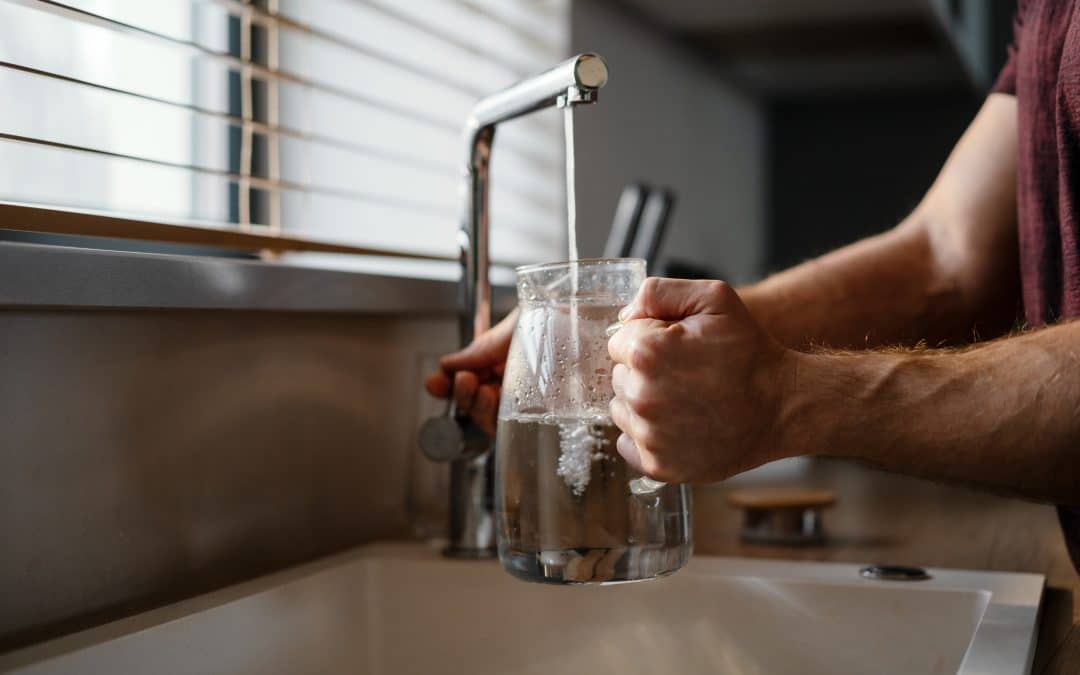
Fill a glass at the kitchen tap, then run the shower for a minute. Some people catch a faint pool smell and some catch nothing, and both are normal. That smell is usually a trace of the disinfectant your utility adds to city water, and it’s what a HALO filter on your main line is built to reduce. Scale is a different story, so this post sorts out what’s solid and what isn’t before you spend a dollar on anything.
Why Does City Tap Water Smell Like Chlorine?
Utilities add chlorine, or in some systems chloramine, to disinfect drinking water. What you smell at the tap is a trace of it. The CDC considers either one safe up to 4 milligrams per liter, so filtering it is a matter of taste. Some people never notice it. Others notice it every time, and either reaction is reasonable. Neither one is an emergency, which means there’s time to compare your options before you buy anything.
Chlorine is only half of what a homeowner on city water has to weigh, though. Minerals are the other half, and your utility’s own paperwork puts numbers on both.
What Does Your Water Report Say About Your Own Tap?
Pull up your utility’s annual water quality report tonight and look for two lines. The first names the disinfectant in use, and since utilities can switch, the answer can change from one year to the next. Howard County buys its water from Baltimore City and WSSC, and Howard County’s 2026 report lists chlorine for both. The second line is hardness, which measures dissolved minerals. The report gives it for the WSSC supply only, at an average of about 70 ppm, and the USGS sorts water hardness into four ranges.
| Hardness (mg/L, or ppm) | USGS label |
|---|---|
| 0 to 60 | Soft |
| 61 to 120 | Moderately hard |
| 121 to 180 | Hard |
| Over 180 | Very hard |
A 70 ppm reading lands in the moderately hard band. The report gives no hardness figure for the Baltimore City supply, so a home on that supply needs another source for the number. A different utility’s report answers the same two questions. I’ll admit an annual water report isn’t anyone’s idea of beach reading, but those two lines take about five minutes to find. Once you have both numbers, you’ve done the hardest part of the homework, and the next question is what a HALO filter does with them.
What Changes Once the Filter Is on the Main Line?
Every tap and showerhead pulls water that has already passed through five stages, so the change reaches every fixture. Think of the main line as the front door for your water. Treat it there and you don’t have to guard every window. Those stages are GAC, HAC, Filter-AG Plus, garnet and the HALO ION magnetic conditioner. HALO designs the system for municipal water, which makes a city connection the starting point for everything that follows.
The filter doesn’t change what your utility puts in the water, and it doesn’t replace reading the utility’s report. It changes what comes out of your taps after the water crosses your property line.
At the Kitchen and Bathroom Sinks
Taste and smell are what you’d notice first. A HALO filter is built to reduce chlorine. The glass you fill and the pot you cook in draw from the same treated line as the bathroom faucet down the hall. A pitcher only helps at the pitcher. The main-line filter covers every sink in the house without anyone remembering to refill it.
In the Shower
A showerhead filter treats one fixture. A filter on the main line sends the same five-stage water to the shower and every other tap. If a chlorine smell in the bathroom bothers you, that’s the change to watch for. Hardness is a separate matter, and it needs a closer look.
What Does a HALO Filter Do About Scale?
Nothing in the system takes hardness out of the water, since the ION stage conditions it and doesn’t remove it. That distinction matters for a supply like the 70 ppm WSSC average. A moderately hard supply stays moderately hard on the way through. How well the conditioning works is where the independent research turns cautious.
A 2014 Arizona State University study for WateReuse found that electromagnetic treatment reduced scale formation by about 50 percent, against more than 88 percent for template-assisted crystallization (TAC). A 2020 review in npj Clean Water covered permanent-magnet devices among others and said the scientific basis for their effectiveness is not clear.
HALO’s own spec sheet adds a disclosure of its own. The Water Quality Association (WQA) certifies the HALO 5 series to NSF/ANSI 61 for material safety and 372 for lead-free compliance. The series isn’t tested or certified by WQA for contaminant reduction or performance.
Read together, those points make the ION stage a possible extra on top of a chlorine filter, with scale performance still an open question. Scale as your main concern is a reason to ask what else would address it directly. Chlorine as your only complaint is a reason to ask how much equipment the job needs. Either question is a fair place to start a conversation.
When Is a Pitcher Enough?
A pitcher that meets NSF/ANSI 42 for chlorine, taste and odor covers drinking water at one tap, and it covers that job well. That standard applies to pitchers and whole-house systems alike, so it gives you one yardstick for comparing them. Look for it on whichever product you’re weighing. Plenty of households will find that one job is the only one they need done.
A pitcher can’t reach the shower or the bathroom sink. It also needs refilling for as long as you rely on it. Those two limits are where a filter on the main line earns its place.
Drinking water alone points to the pitcher. Add the shower to the list, or add a preference for not thinking about it at every tap, and the main line becomes the better fit. Once you’re leaning that way, a short list of checks comes before anything gets scheduled.
What Should You Check Before You Buy a HALO Filter?
Four questions cover most of the decision, and you can start on them from your kitchen table. Bring them to any HALO conversation, including ours:
- Which disinfectant your utility uses, chlorine or chloramine, as stated in the annual report
- Whether the 1,000,000-gallon rating, which HALO bases on chlorine at 1 ppm, fits the level in that report
- Where the required drain line and 15-volt transformer would go
- Whether your home runs on city water, since HALO wants a current well water report for its own analysis and skipping that voids the warranty
The first two come from paperwork you can find today. The last two depend on where the main line enters your house, so they need a set of eyes there. A drain line gives the system somewhere to send its discharge, and the transformer gives it power. Both are easy to picture once someone stands in your utility room and hard to judge from a photo or a blog post.
That’s also where a diagnosis belongs. Nobody can size up a specific house from an article, and we won’t try.
Talk Through Your Water With PlumBubble
A filter on the main line treats every tap and shower from one spot, and chlorine is what a HALO filter is built to reduce. The ION stage conditions hardness, though the independent evidence on how well it does that is mixed, so go in with clear eyes. A pitcher will do the job for plenty of households. Once you’ve read your utility’s report, the hard part’s done.
Talk to a local plumbing professional at PlumBubble Plumbing Services about your water. We’ll look at your own setup and explain how a HALO consultation works and what it costs before anything starts.